Saturday, February 1, 2025

What Do You Meme?

Most people have only a superficial understanding of what "meme" means. [The alliteration is purposeful and has meaning to me. You, too, should understand soon.]  Those who use the word “meme’ are likely also to know “mimetic,” but may or may not connect the two terms. If you are reading this mindfully, you will see clearly that the second letter in the two targeted words are different -- e vs. i . That's because they  are not etymologically related.  Since both terms are frequently spoken and written, I thought it might be useful to consider them as a way to sensitize us all to what we are saying and hearing.

The words meme and mimetic do share a common conceptual root but, as noted, they have distinct etymologies and distinct meanings, as well.  When most people speak about a meme, they mean an idea, icon, object, or action that is current and popular. But that does not conform to the original definition. 

Dr. Richard Dawkins in the Selfish Gene introduced "meme" in 1976 as a “gene" analogue that referred to a unit of cultural transmissions similar to the bodily transmissions from a gene. To him, memes, like genes, needed to possess fidelity, (be a faithful copy) fecundity (spread widely) and longevity (have long-standing influence). Of course, those three criteria can be interpreted subjectively or objectively. Regardless of whether the subjective or objective standard is applied, however, most often when I hear or read someone referring to a meme, it does not satisfy the required three criteria. So, I feel that using the word meme often is unnecessary and/or meaningless. Perhaps the user is trying to impress rather than inform. Instead of incorrectly using the word meme, for instance, why not just say "popular"--a less ambiguous word that conveys the intended idea? 

Unlike meme, "mimetic" has a long history in classical philosophy wherein it indicated the process of imitation, especially imitation in behavior or art. The original use of this word was qualitatively different than today's colloquial meaning--something mimetic had to include imitation of reality, representation of reality in a manner that evokes clear recognition or understanding, and verisimilitude (truth likeness) that strives for a degree of believability or truthfulness. It may not be an exact replica of reality but should resemble it enough to be recognized as an authentic representation, an interpretive aspect of the world, and also be a creative transformation of the original.

My point in contrasting the original and colloquial uses of the terms meme and memetic certainly is not to suggest what is absolutely right and what is absolutely wrong conversationally.    Instead, I’m intent in underscoring that people are sometimes more interested in signaling their identity or tribal affiliation than they are in communicating clearly.  I’m sure you are well aware of Matt Walsh’s documentary, What is a Woman? (2022) and of the sex and gender-oriented Congressional hearings that illustrated the language absurdity and confusion attendant to a simple discussion of male-female differences.

There is nothing wrong in judiciously, infrequently  using  memes given certain conditions.  First, your use of the meme must be similar to the use of the meme of your interlocular. Second and most important, you are using the meme mindfully, not merely in rote imitation. Don’t present a prefabricated, popular meme that may not really reflect nuances of your personal idea.  Speak with as much precision as possible.  Then even if you use a meme, it will not be purely imitative, but closer to mimetic. For instance, rather than saying “at the end of the day," perhaps your idea would be better expressed with a phrase like “in the final analysis” or something even more creative and personal. Communicate primarily to transmit clear meaning rather than status or group affiliation.

Wednesday, January 1, 2025

Marines and Identity Signals

January 4, 2025 is the 60th anniversary of my arrival at Marine Corps Depot, Parris Island, South Carolina for the onset of a 4-year USMC active enlistment.  In thinking about that, I reflect upon the fact of my lingering Marine identity, and what it might suggest about identities in general.  Let’s start with my, admittedly bizarre, experience in Spain when vacationing there a few years ago. The incident occurred while I was waiting for a bus at a crowded stop.  A stranger with a heavy Scottish accent walked up to me and said, “You were a Marine.” In total shock, I asked, “How did you know?” to which he replied, “I worked as a civilian on a Marine base for 20 years. You all wear your hat the same way.”  I never had thought about hat-wearing as significant or even noteworthy.  At the time, mine was a plain baseball cap with no logo or words whatsoever.  My best guess is that the distinctive feature was do to the facts that I wore the hat tight to my head, pulled close to my eyebrows, and that I had squeezed the visor into a virtual semicircle. Only days later did I recall one and only one Marine-relevant fact—that my boot camp drill instructor did require us to measure two fingers above our eyes as the resting point for our “covers” [hats].  So, six decades later, I continue to unconsciously imitate behavior acquired in a long-gone context.    

We all share my Scotsman’s proclivity for interpreting identity based upon superficial appearances. Imagine walking into a bustling café, the hum of conversations filling the air, and taking a seat at a corner table. Without exchanging a single word with anyone, you begin to notice the people around you. A man in a tailored suit sips his espresso while glancing at his tablet. A young woman with brightly dyed blue hair and a collection of pins on her backpack sketches in a notebook. Across the room, a couple wearing matching workout gear share a smoothie after what looks like a rigorous morning run. Each person is silently telling a story about who they are, using the subtle language of nonverbal cues and personal presentation.

Clothing is often the first thing that catches your eye. It’s not just fabric and stitching—it’s a form of communication. The man in the suit might be signaling professionalism or the importance of his role at work, while the young woman’s vibrant style and unique accessories suggest creativity and an alignment with subcultures or causes she’s passionate about. Traditional garments, like a hijab or kente cloth, may express cultural heritage or a deep connection to personal identity. Each choice, whether intentional or subconscious, reveals something about the wearer’s world.

Next, you notice how people carry themselves. The man in the suit sits upright, exuding confidence, his movements deliberate and measured. The young woman leans over her sketchbook, her shoulders slightly hunched, perhaps signaling intense focus or introversion. Body language is a powerful communicator of emotions and personality. A relaxed stance with open gestures can suggest approachability, while crossed arms and a downward gaze may hint at discomfort or defensiveness.

The café patrons’ physical appearances also provide subtle clues. Age lines on a face might hint at life experience, while ethnic features or hair texture can reflect ancestral heritage. The couple in matching workout gear, with their toned physiques, likely share a commitment to health and fitness, which might even be a cornerstone of their relationship. 

Your attention might be drawn to the young woman’s arm, adorned with intricate tattoos. Each design seems deliberate, like pieces of a puzzle telling a deeply personal story. Tattoos and body modifications often reflect significant life events, cultural affiliations, or deeply held values. Whether it’s a small, minimalist design or a full sleeve of vivid imagery, these marks are windows into the wearer's personal journey.

If you observe further, even grooming habits become part of the narrative. The man’s neatly combed hair and polished shoes might reflect a lifestyle of precision and order, while the woman’s bold blue hair and artistic vibe could signify rebellion against convention or a creative spirit. Makeup choices—whether bold or understated—also serve as a canvas for self-expression.

As I often do, it’s time for me to emphasize the role of context in determining your observations. In a café like this, you might guess that the suited man is a busy professional taking a break from his workday. The sketching woman could be an art student or a freelancer finding inspiration. The couple in workout gear might have just come from a nearby gym, prioritizing health and shared routines. Where people are and what they’re doing often provides a frame for understanding their identity. 

Although silent cues are intriguing, it’s important to approach them with sensitivity and humility. While appearances offer clues, they don’t tell the whole story. People are complex, and their identities are multi-layered, often defying easy categorization. Behavior always is multi-determined. The man in the suit might be heading to a job interview rather than a board meeting. The young woman with the blue hair might be an introvert finding her voice through art. Identity assumptions, even well-intentioned ones, are always provisional hypotheses that need to be supported or refuted.


Sunday, December 1, 2024

Influenced by Influencers ?

The power of influence largely derives from the ways that it appeals to our cognitions and emotions. Professional influencers have clear, specific goals that they hope to achieve. They first strive to seize your attention. Then they seek to prepare you cognitively and emotionally to receive their message before they begin to deliver it. Once that is attained, they want to ensure that your frame of mind continues to remain as fully consistent with their goals as possible. In the language of psychology, that means the influencer offers “advance organizers” intended to create in you an enduring “mental set” that renders you continually susceptible to them. Further, because the influencer knows that his likelihood of success depends on how you align with him, he wants to make you feel that he values you. To do so, he might appeal to any of your thoughts and/or emotions. In the present chapter, we look at your mental functions that can be manipulated by those who want to exert their control, and how they might do so.    

Attention  

Most of our mental functions are steered by attention—attention that can be deliberate or incidental. “Attention capture” is a marketer’s first objective. They understand our primitive orienting response by which we turn our attention to a sudden and/or distinctive environmental stimulus. For instance, in the recent past, we all noticed that television commercials typically had broadcasted louder than the shows that they accompanied. After a citizen revolt, the United States government passed the Commercial Advertisement Loudness Mitigation (CALM) Act. However, on their website, (https://www.fcc.gov/consumers/guides/loud-commercials-tv), the current Federal Communications Commission (FCC) rationalizes that “Some commercials with louder and quieter moments may still seem ‘too loud’ to some viewers, but are still in compliance because average volume is the rule. The FCC does not monitor programming for loud commercials. We rely on people like you to let us know if they think there's a problem. If you have experienced what you believe is a violation of the rules regarding the loudness of commercial TV ads, you may file a complaint with the FCC at no cost.” 

Whether watching television or strolling the avenue then, we ultimately are responsible for deciding how we direct our deliberate attention. That is a first step in maintaining control of our decision making. Individuals who deliberately attend to every new stimulus, fad, or circulating meme will find plenty of reasons to be influenced. Incidental attention, obviously, is less amenable to conscious control, but not totally intractable; we manage it by confining ourselves, as much as possible, to non-coercive places, people, and information. The more we position ourselves in open settings populated by open people, the more we can maintain and express our own opinions, and rationally evaluate the external influences exerted upon us. When we are in closed settings populated by chauvinistic people, we are less prepared and less inclined to resist their influences ...     The preceding is a brief excerpt from my book --  Justifiably Paranoid: Resisting Intrusive and Malicious Influences  https://www.amazon.com/Justifiably-Paranoid-Resisting-Intrusive-Influences/dp/1793449597?ref_=ast_author_dp

Sunday, October 27, 2024

Misinformation, Disinformation, Voting, Etc.

Especially now, with the United States presidential election at hand, we are assailed by a never-ending barrage of comments about misinformation and disinformation. So, I wonder, what is the difference between the two and what are the implications?  One way to differentiate is to say that misinformation is merely something objectively wrong.  Whereas disinformation is objectively wrong and vigorously, manipulatively propagandized. Both definitions lead to further questions.  First, how can we be sure that we know what is objectively wrong?  Second, what does the propaganda promote?  An in-depth discussion of these questions is far beyond the scope of a modest blog post such as this.  However, the fact that I’m writing about it means that I think I have something useful to contribute. 

Let’s presume for the moment that you are confronted with information, and have access to the source (s) that will allow you to identify and determine relevant objective truth.  Equally important, you resolve to accept the relevant objective truth when you find it.  Persons who are mindfully reading will realize that nothing that I’ve said so far is easy. Some might say that much of what I have said so far is virtually impossible. For both groups, I hear you.

How do we proceed, then, to assess the proffered information?  An initial consideration is to decide whether it is “mal-information”—implying the possibility of bad or evil influence. Of course, what is bad and evil require value judgement.  For instance, murder is abhorrent, but it would neither be bad nor evil, I think, to murder someone who is about to slaughter an innocent family. 

Human beings naturally default to what Daniel Kahneman (2011) called “System One” thinking, by which he meant thinking that requires the least amount of effort. Accordingly, I’m asking you to resist the natural inclination to default to System One, but to put forth more deliberate mental action than usual.  I justify my request by returning to the mal-information concept. Since mal-information deals with values, you need not burden yourself by ruminating about each piece of new data that you encounter, only about what you truly value.  Complicating things, however, is the uncomfortable truth that I mentioned earlier—that deciding what you value is itself a value judgment.  Then gather as much objective, relevant data as possible, and mindfully process it to the extent that you’re able.  All this requires commitment and independence of thought that enables you to resist exogenous influences

When you’re in a reflective mood and have the time available, I suggest that you sit down and list your core values. You might do so in a kind of hierarchy. For instance, you could list the values that you have for yourself as an individual, the values that you have for your children—if you are a parent— and for your family—if you have one—the values you have for your friends and neighbors, and the values that you have for your town, state, and country.  After that exhausting exercise, you will appreciate the difficulty of determining your values, and—more important—of deciding what to do about the values that you truly embrace.  Ideally, going forward you will be less inclined to disparage others and slander them with ad hominem attacks whenever they make some non-valued comment at odds with your System One beliefs.  That stance will help combat the rampant contemporary interpersonal conflicts plaguing us and our nation.

Earlier, I asserted that your ability to assemble objective, relevant data and to mindfully process it requires you to value independent, autonomous thought that resists exogenous influences.  In other words, after adequate reflection, you must VALUE and TRUST yourself above all outside implicit and explicit pressure.  For many of us, that means that the values are solidly based on the best authentic data that we can find, and, importantly, that we do not mindlessly succumb to our “tribal” standards to earn social approval. Resist the "bandwagon effect" by which you simply jump aboard the latest and/or loudest group-promulgated ideas.  By default, assume that virtually your entire tribe is using System One—not having mindfully thought through whatever they are endorsing.  Your own value-guided research alone ultimately should determine what is and is not mal-information. If you do that and vote accordingly, you need not answer to anyone. 

Reference

Kahneman, D. (2011). Thinking, Fast And Slow.  New York: McMillan 

Tuesday, October 1, 2024

Be Quiet !

Since Socrates lived from about 470-399 B.C., one reasonably can assume that many deep thinkers have valued and practiced what we presently call the Socratic Method for at least the last 2500 years.  You no doubt know that the method employs a questioning and answering format, frequently called dialog-based inquiry.  The process can be slow and even tedious.  Is it worth the effort?  Hopefully, yes.

When conducted properly, the Socratic Method enables both questioner and answerer to learn. And that learning is not limited merely to acquiring objective information.  Both also learn about themselves, about each other, and about the way they think, as individuals and as a dyad.  Ideally, their ideas are critically examined, reflected upon, and refined.  It’s no secret that often the putative experts learn as much or more than the novices with whom they are dialoging.  So, those are some benefits to dialogic discourse. 

Non-dialogic discourse, then, produces one-sided communications or actions that inhibit both objective learning and mutual understanding. Before you can avoid `those problems, of course, you first must be mindful of the most common dialogue impediments.  Among these are:

Monologue: One person dominates the conversation without allowing others to contribute.
Authoritarianism: Imposing one's ideas or viewpoints without considering or engaging with others’ perspectives.
Interruptions or Dismissals: Cutting someone off before they can fully express themselves or dismissing their opinions outright.
Lack of Listening: When one party does not actively listen or show genuine interest in the other person's point of view.
Ignoring Feedback: Failing to respond to or acknowledge the other person’s input.

There is another very critical issue that I never have seen or heard anyone explicitly raise.  It is one that I introduced and discussed at length in my Questioning & Answering book.  In brief, I suggested that one can have discussions that pose as dialogic but clearly are not.  I have termed one of these as “incompatible message and/or relationship pseudo-dialogue” (IMRD). These occur when interlocutors’ talk masquerades as dialogue, but really is non-dialogic attack.   Often the topic is a proverbial hot-button issue, such as political, religious, or racial opinions.  The varieties of assault also are discussed in my Questioning & Answering book.  Two common ones are the “ad hominem” attack wherein a derogatory claim is lodged against an interlocutor rather than commenting on the objective topic being addressed.  Another is “guilting” in which the attacker tries to make the counterpart feel solely responsible for a problem. Both these IMRD attacks explicitly or implicitly weaponize message and relationship emotion to win a battle rather than rationality to argue an objective point.

 You know that you are in a IMRD relationship when any single or combination of he following obtains:

1. The talk is primarily parallel monologue instead of reciprocal dialogue.
2. There is lack of emotional or intellectual intimacy.
3. The focus is transactional, based only on practical or superficial needs.
4. You perceive lack of empathy and responsiveness.
5. One person employs significantly more power or authority during the encounter.

To facilitate dialogic discourse, be responsible and proactive.   Ensure that you are not weaponizing.  Do your best to promote authentic dialogue.  Refuse to participate in IMRD.  When it begins, label it immediately and explicitly. Invite a restart, but with the stipulation that honest, open, objective dialog scrupulously must be maintained.

Wednesday, September 11, 2024

Presidential Election Psychology

This blog post is written on September 11, 2024, a day after the first Trump-Harris televised debate.  Private and public speculation has been frenzied and frantic.  Some have suggested or implied that the fate of America, even of the planet, will be determined by the presidential election—“the most important election in our history.”  Democrat and Republican partisans are employing every influence trick to nudge, scare, or bludgeon you to vote their way.

I am not in that business.  Rather, I have a modest suggestion that is easier said than done: think, really think, for yourself.  Since neither you nor I have the time or expertise to parse every essential detail required to make the best voting decision, I limit myself to briefly discussing two related topics.

First, let’s consider an often mentioned but rarely practiced mental activity – mindfulness.  Our simple working definition is mindfulness as your being aware of what is happening to you internally and externally.  For instance, when you see a Harris or Trump advertisement do you reflexively nod or shake your head, smile or snarl?   If your response precedes any point that the advertisement proffers, you are not being mindful.  Of course, you can justify your affirming or negating reflex by indicating – correctly – that the ad is meant to get your vote independent of its truth value.  You can justify that instinctive, mindless agreement or disagreement with any bit of information about Trump or Harris, regardless of its source or validity.  As you may have experienced, many family or friend feuds have their origins in the affirming or negating reflex that makes any political discussion useless and/or contentious.

Why the absence of rationality?  Chang, J., Kuo, C., Huang, C. et al. (2018) approach the issue indirectly by considering both reactive and proactive cognitive control mechanisms.  The former refers to thought that is “top-down” in the sense that our preexisting thoughts overwhelm our interpretation of present information such that they stifle the incoming information.  The latter is the opposite – bottom-up - in the sense that incoming information is processed before preexisting thoughts significantly impact it.   The study in question found that high mindfulness individuals were able to evidence adaptive reactive and proactive cognitive control whereas low mindfulness ones relied excessively on proactive control. 

This finding leads us to a second often-mentioned concept – confirmation bias.  As you probably know, confirmation bias causes us preferentially to seek information that reinforces our current beliefs and to avoid information that contradicts them.  That is, confirmation bias is exclusively top-down/proactive.

Mindfulness, then, is most often an advantage in virtually all mentation.  Do you tend toward mindfulness?  Psychologists would like to be able to differentiate those who do from those who do not.  Toward that end, Altizer, Ferrell, and Natale (2020) investigated mindfulness and personality types.  They concluded that mindfulness was more prominent in “well-adjusted” persons, since they are inclined to cope adequately with stress.  Similarly, mindfulness tended to be higher in ambitious persons, but only those whose ambition included a high level of positive human relationships.  The Altizer group proposed that mindfulness was less present in overly cautious, defensive, and excitable persons.

What does all this say regarding the Harris-Trump election?  The obvious conclusions are that we would do well to be as mindfully open-minded as possible, and by refraining insofar as possible from confirmation bias.  You can facilitate those processes by:

1.             Taking a deep, stress-reducing breath when confronted with election ads and other influencers, animate or inanimate.

2.             Considering how your election attitudes are affecting your personal well-being, your interpersonal relationships, your descendants, and the welfare of our nation.

3.             Trying to reduce your defensiveness.

4.            Voting according to policies rather than personalities.

A final point about which I never have seen research, but that deserves it: selective mindfulness.  By that I mean being attentive and rational about one feature of reality and not about another closely related feature.  Applying the idea to the election, that would concern being mindful about a democrat or republican, but failing to be so about the opposite-party candidate.  Please think about whether selective mindfulness or MINDLESSNESS applies to you, and about how it could influence how you decide to vote.

References

Altizer, C. C., Ferrell, B. T., & Natale, A. N. (2020). Mindfulness and personality: More natural for some than others and how it matters. Consulting Psychology Journal: Practice and Research. Advance online publication.   http://dx.doi.org/10.1037/cpb0000189

 Chang, J., Kuo, C., Huang, C. et al.   The Flexible Effect of Mindfulness on Cognitive Control.  Mindfulness 9, 792–800 (2018). https://doi.org/10.1007/s12671-017-0816-9


Friday, August 30, 2024

Hypocrisy? Cowardice? in Psychology and Science

 Clinical psychologists explicitly or implicitly communicate to patients the importance of their speaking as honestly and completely as possible, especially when asking and answering questions.  And, expecting honesty and completeness, non-clinical psychologists regularly use surveys of various sorts to conduct their research. Given that honest and complete communication often requires courage and resolve, Cory J. Clark and colleagues (2024) wondered whether psychologists had sufficient grit and conviction to follow their own advice.  Their study was important because the psychologist-participants were university professors-- meaning that they profoundly influence the current and future direction of psychologists, psychology majors, and students of all other majors enrolled in their classes. The candidate professors taught at “the top 100 universities and the top 100 psychology graduate programs in the United States according to U.S. News & World Report rankings.”  The study was even more important because many, if not most, of these very accomplished students presumably will become leaders of American people and policies.

At the end of 2021, the investigators solicited participation of 4,603 psychology faculty members.  Only about 10 percent (N=470) agreed to answer questionnaire items, and not all answered all questions.  Moreover, even fewer participants (N= 417) revealed their demographic information.  Most of these intrepid? psychologists / scientists apparently feared answering and/or accepting personal responsibility for answering at least some of the following questionnaire items:


“The tendency to engage in sexually coercive behavior likely evolved because it conferred some evolutionary advantages on men who engaged in such behavior.”

“Gender biases are not the most important drivers of the under-representation of women in STEM fields.”

“Academia discriminates against Black people (e.g., in hiring, promotion, grants, invitations to participate in colloquia/symposia).”

“Biological sex is binary for the vast majority of people.”

“The social sciences (in the United States) discriminate against conservatives (e.g., in hiring, promotion, grants, invitations to participate in colloquia/symposia).”

“Racial biases are not the most important drivers of higher crime rates among Black Americans relative to White Americans.”

“Men and women have different psychological characteristics because of evolution.”

“Genetic differences explain non-trivial (10% or more) variance in race differences in intelligence test scores.”

“Transgender identity is sometimes the product of social influence.”

“Demographic diversity (race, gender) in the workplace often leads to worse performance.”

The investigators asked psychologist-participants how much, if at all, they believed that the questionnaire respondents might not answer the “taboo” items openly due to concerns about:


Being ostracized by some peers

Career-damaging biases against me (e.g., in publishing, promotion, awards, grants, talk invites)

Being stigmatized or labeled pejorative terms

Disciplinary actions (e.g., losing classes, losing leadership roles, formal reprimand)

Guilt-by-association harm to my students and colleagues

Being fired

Being attacked on social media

Student boycotts

Threats of physical violence

Persons who remain curious about the study can fully access it via the reference that I cite below.  Because its psychologist-participants lacked the courage to cooperate adequately, this study failed abysmally in its well-intended attempt to generate useful information.  In the interest of brevity, I will not belabor you with the minutiae of this grossly inadequate study.  My point is not to explain reasons for the cowardice, hypocrisy, or corruption of psychology, but to underscore contemporary threats to science, in general, even to the so-called “hard sciences.” (See Restoring the Sciences: Science Under Attack, 2023) I am sure that everyone reading this posting is quite familiar with the basic tenets of scientific inquiry.  We have been taught since grammar school how it should proceed.  In simplest terms, there usually is: Observation, Question Formulation, Hypothesis Development, Experimentation or Some Other Objective Valid and Reliable Means of Assessment, Data Collection, Analysis, Conclusion, Communication About the Issue and Conclusion, Peer Review and Replication, and, often, Theory Development.

Although in the typical explanation of the scientific method, only step eight specifies the word “communication.”   However, communication is ubiquitous in real science—communication with other past and present scientists, if only via impersonal written, visual, and oral material.  All this, of course, presumes that scientists honestly say what they mean when they mean it. Decide for yourself whether those qualities are common and pervasive in contemporary American (and Western) science.   If you agree that the topics studied by Cory J. Clark and colleagues (2024) really should be “taboo,” ask yourself who will decide the next batch of taboos and whether you will agree with them.

There is an even larger national problem implicit in this study, however. We know that countries fail when leaders’ surround themselves with advisors afraid to tell them what they truly believe. That circumstance can lead to wars and to disintegration. I hope that the psychological study just reviewed is not the proverbial canary in the coal mine that signals American retreat from vigorous open and honest questioning and answering of all issues—scientific and otherwise—essential to our nation’s growth and survival.  Do you care enough to speak against science and social censorship? If you do, consider following and/or joining the non-partisan free speech group, FIRE | Foundation for Individual Rights and Expression at  https://www.thefire.org/

References

Clark, C. J., et al. (2024).  Taboos and Self-Censorship Among U.S. Psychology ProfessorsPerspectives on psychological science. May 16     https://orcid.org/0000-0002-3083-9179

National Association of Scholars (December 08, 2023).  Restoring the Sciences: Science Under Attack.  https://www.nas.org/blogs/media/video-restoring-the-sciences-science-under-attack

Thursday, August 1, 2024

Homeostasis and Allostasis

Virtually everyone is familiar with homeostasis.  To refresh that concept: it refers to the fact that a healthful physical condition must be maintained within a narrow range regardless of the external environment  wherein we find ourselves.   Among  the many processes to be maintained are those such as temperature control, pH balance, and glucose levels. 

Not so widely known,  however, is the allostasis concept—the process by which the body regains homeostasis when homeostasis is challenged or lost due to stress.  Some of the stressors are purely physical, such as frigid weather and some are less so, such as angry disputes.  Most stressors, of course, include an amalgam of physical and non-physical stress (e.g., mental) in various combinations.  Unlike homeostasis, allostasis operates by ANTICIPATING increased bodily demands and challenges.  For instance, allostasis begins to operate long before your body temperature has deteriorated to a critical, life-threatening  level.  ALLOSTATIC LOAD is defined as the bodily wear and tear (e.g., heart disease) due to chronic stressors  whether more physical, more mental or a combination of both.

To a considerable extent, our health and happiness depend on how we manage our physical and non-physical allostatic load, and  the management often is very difficult.  We have an improved chance of succeeding if we augment the automatic, unconsciously directed allostatic  physical anticipation with a consciously directed allostatic  mental anticipation.   Ideally, we must  develop the habit of anticipating stressors before they occur, or at the very start of their deleterious action.

Because physical homeostasis and physical allostasis  are automatic, we rarely think about their functioning.  So, we are unlikely to attempt to predict their failure, and we do not feel responsible when they do fail.  By contrast, we can exert a modicum of both mental homeostasis and mental allostasis stress influence by the manner through our by employing  stress anticipation.  Sometimes that stress anticipation enables us to forgo or mitigate stress, and sometimes it causes us to instigate or accentuate stress.  In the latter case, we increase our stress and allostatic load only eventually to discover that the anticipated stressor never materializes.

One common cause of mental stress  and its mental allostatic load  is our mistakenly using affect (emotion) as information  (Schwar, & Clore, 1983).  But unlike the just-cited authors, I must replace their use  of the generic word “information” to my phrase, OBJECTIVE  DISPASSIONATE VALID INFORMATION.  I do so  because affect is information that , at minimum, is a highly personal, sometimes idiosyncratic, emotional information signal, causing us to predict that something noteworthy might, will, or soon will occur.

The major issue, of course, involves what one does with the affective information signal that is received.  Try transforming  an uncontrollable, affective information signal into controllable, objective  dispassionate valid information by asking yourself  questions such as the following:

Am I about to improperly use my CURRENT emotional state as a heuristic or shortcut when making judgments or decisions. For example, if I am feeling  poorly right now, will I evaluate a situation more negatively than is warranted, or vice versa?

Am I about to attribute my current feelings to the wrong source and make an unwarranted decision?

Might my present affect be more current context-dependent than I realize,  causing me to make a decision now that harms my long -term well-being?

Conversely, could my present affect prompt me to overestimate the impact of my current decision on future events that will deleteriously influence my emotional well-being?

The bottom line of all this is to say that we should mindfully think about all our homeostatic and allostatic circumstances in order to reduce our stressors or, at least, to better cope with them.  However, since we have relatively greater control over our mental homeostasis and mentally-induced allostatic load, that should be our central concern.  Moreover, given that the social environment usually is our most common and intense form of encountered stress (Almeida, 2005), we should strive to maximize our salutary interpersonal relationships and minimize our negative ones.   

REFERENCES

Almeida, D. M. (2005).    Resilience and Vulnerability to Daily Stressors Assessed via Diary Methods

Current directions in psychological science, Volume 14, Issue 2.   https://doi.org/10.1111/j.0963-7214.2005.00336.x


Schwarz, N. & Clore, G. (1983). Mood, misattribution, and judgments of well-being: Informative and directive functions of affective states. Journal of Personality and Social Psychology, 45(3), 513-523. doi:10.1037/0022-3514.45.3.513


Monday, July 1, 2024

Swallowed Up and Excreted Out: Miseducating Americans

In the not-too-distant past, there was a common perception of a young person’s transition from high school graduation to higher education. The newly liberated ex-high-schooler was believed to leave 12th grade with an excessively limbic, subcortical operating system dominated by raging hormones and rebellious mindsets. Then, learned implacably rational professors performed pedagogical brain interventions that stimulated the prefrontal cortex such that it eventually surged into prominence, resulting in higher education graduates who could and did employ independent rationality to reach critical life decisions. 

Given the current 21st century state of higher education, however, I have transformed my higher education neurology-brain metaphor to an gastrological-alimentary one.  Contemporary higher education students are not stimulated to frontal lobe engagement by their universities.  Rather, the hapless victims are consumed by universities that extract student intellectual nutritive resources, and infuse their depleted heads with boluses of manipulative propaganda. Too often, the universities' strive to produce students who eagerly, willingly excrete retained propaganda residua, thereby fertilizing extant American mindlessness to further the goals of elitists, so-called intellectuals, business tycoons, and popular social influencers who control higher education. 

Young people are not being encouraged how to think, but coerced into what to think and when.  Even more destructive is how viciously and relentlessly the few brave student propaganda-orthodoxy-resistors are attacked and demoralized.  

As George Orwell asserted, "Freedom is the freedom to say 2 plus 2 makes four. If that is granted, all else follows."  Given that I'm an old man, young people reading this blog posting might have more confidence in Chat GPT's interpretation of the Orwell quote than mine. Accordingly, the "great and powerful" artificial intelligence sage reports "George Orwell's phrase 'Freedom is the freedom to say that 2 + 2 = 4' comes from his dystopian novel 1984. This statement encapsulates a fundamental idea about the nature of truth and the importance of intellectual freedom ...Orwell's statement highlights the importance of protecting intellectual freedom and the right to speak one's mind. It underscores that without the ability to acknowledge reality, all other forms of freedom become meaningless. The phrase serves as a warning against the dangers of authoritarianism and the erosion of objective truth."

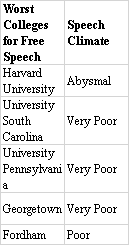
Let’s see how the non-partisan organization  FIRE | Foundation for Individual Rights and Expression rates the intellectual and free-speech integrity of some elite universities that purport to educate our students.


So, we see that many elite university students are taught "proper" identity-oriented thoughts in compliance with  professor-curated identity dogma as the first, primary, and often, sole sieve through which all information must flow and be evaluated for righteousness.  Moreover, the sieved information then is gospel, not to be tested, but to be unquestioningly  implemented in daily life.  

American elitists and intellectuals relentlessly chant the mantra, "Our diversity is our strength" to shame anyone who makes comments that they define as socially non-inclusive or derogatory.  Those same elitists and intellectuals, however, unceasingly try to impose their Orwellian control over any of our contrary thoughts, speech, and actions. To them, diverse thoughts, speech, and actions are evil and must be eradicated.  

Finally, I am well aware that most people reading this blog probably are far beyond college graduation age and many have no college-age loved ones. However, because you and I are being inundated daily by misinformation messages across all media platforms, I hope you will consider how to assess questions and answers in a manner that I describe in my Questioning & Answering (2023) book, a very small example of which is:

QUESTION

Message

Relationship

Credibly Generated by Questioner

Comprehensible to Question Receiver

Well-Intentioned by Questioner

Well-Received by Question Receiver

ANSWER

Message

Relationship

Credibly Generated by Answerer

Comprehensible to Answer Receiver

Well-Intentioned by Answerer

Well-Received by Answer Receiver


References

McCusker, Peter J. (2023) Questioning & Answering: How, Who, When, & Where.  Seattle, Washington: Amazon Publishing 

NEW: 2024 College Free Speech Rankings show alarming 81% success rate of deplatforming attempts at nation’s most censorial schools

https://www.thefire.org/news/new-2024-college-free-speech-rankings-show-alarming-81-success-rate-deplatforming-attemptshttps://www.thefire.org/research-learn/2024-college-free-speech-rankings


Wednesday, May 29, 2024

Sone-Aged Living

Recently, on the Mediterranean island of Malta, I lay my left hand on a multi-thousand year old megalith while holding a 2024 mobile phone in my right. And I wondered about the people and lifestyles responsible for both.

The Megalith Builders of Malta lived approximately in 3000 BC—during the New Stone Age— on an island 17 miles long and 9 miles wide.  Since the island had no known volcanos, the air presumably was relatively pure.  The natural environment contained mammals, such as red deer, wild boar, rodents, and sea life, such as fish, dolphins, and seals. The fabricated environment was created through the efforts of small family- and kin-based groups.  Using stone tools, animal bones, and wood, the inhabitants  created what arguably are among the oldest megaliths on earth, consisting of a series of large stone blocks, some weighing several tons. They sustained themselves through farming, herding, and fishing. In short, the world of the neolithic Maltese required its inhabitants to know each other, work together in relative harmony, know their natural world, and live in harmony with it, also.  When times were tough, the population might struggle, but they had reasonable control over their most basic requirements for life and comfort.

How does this compare with the world of the mobile phone producers?  Those producers live in an un-natural environment characterized by grossly polluted land, sea, and air, due to their own activities and senseless exploitation.  There is not a single person on earth who can lay their hand on a completed mobile phone and take credit for having majorly fabricated it, only for adding or subtracting some small piece. 

Few 21st century humans realize that their activities are largely implicated in causing the daily extinction of about 150 species.  What risks have we lovers of mobile phones created to our own destruction?  To cite just one area, most military experts estimate the following nuclear weapon stockpiles: United States: Approximately 5,428 nuclear warheads, Russia: Approximately 5,977 nuclear warheads, China: Approximately 410 nuclear warheads, France: Approximately 290 nuclear warheads. United Kingdom: Approximately 225 nuclear warheads. Pakistan: Approximately 165 nuclear warheads.  India: Approximately 160 nuclear warheads. Israel: Estimated to have around 90 nuclear warheads (Israel has not officially confirmed its arsenal). North Korea: Estimated to have 40-50 nuclear warheads (estimates vary due to the secretive nature of the regime). The destructive power of a nuclear warhead varies greatly from weapon to weapon. Two examples are the U.S. W88 warhead, deployed on Trident II submarine-launched ballistic missiles, with a yield of approximately 475 kilotons, and the  Russian SS-18 (Satan) ICBM with a yield of up to 750 kilotons.  For comparison,  the bomb dropped on Hiroshima, known as "Little Boy," had a yield of approximately 15 kilotons of TNT, and the one on Nagasaki, known as "Fat Man," had a yield of approximately 21 kilotons of TNT.

Don’t take a deep breath anywhere on planet earth to try to relax, yet.  First, read my following quote from the environmental scientists Angela Patricia Abad Lopez, et al. 2023).


Microplastics (MPs) are micro-particulate pollutants  present in all environments whose ubiquity leads humans to unavoidable exposure. … MPs-induced cytotoxicity stimulates oxidative stress by generating free radicals that originate from ROS [Reactive oxygen species, rare unstable oxygen-containing molecules that are created when air pollutants trigger a chemical reaction in the respiratory tract's epithelial lining fluid] and whose overproduction can alter cell homeostasis. Inflammatory lesions, metabolic alterations, and increased risk of cancer are some of the health implications caused by MPs when they encounter the interior of the body.


If you value your mobile phone, you might pity the “primitive” neolithic Maltese megalith builders.  They had no choice but to talk face-to-face with their contemporaries and be immediately responsible for what they said.  By default, the megalith builders breathed unpolluted air, ate natural food, exercised merely as a consequence of living their lives, slept under a blanket of stars, and mostly experienced stress that was immediate and short-lived. I’m sure I would not have enjoyed being sick on neolithic Malta, but, when I was healthy, daily life would have conferred many salubrious benefits, provided that I could endure the “unremitting pain” of living without a mobile phone. Whether you would prefer the life of the megalith builders or contemporary citizens, one thing is for sure—the biosphere undoubtedly would encourage us to choose the former.  Perhaps we all would be healthier if we live closer to, but not identical to, how the Maltese megalith builders did.

Reference

Angela Patricia Abad López, Jorge Trilleras, Victoria A. Arana,  Luz Stella Garcia-Alzatec,  and  Carlos David Grande-Tova.   RSC Adv. 2023 Mar 1; 13(11): 7468–7489